

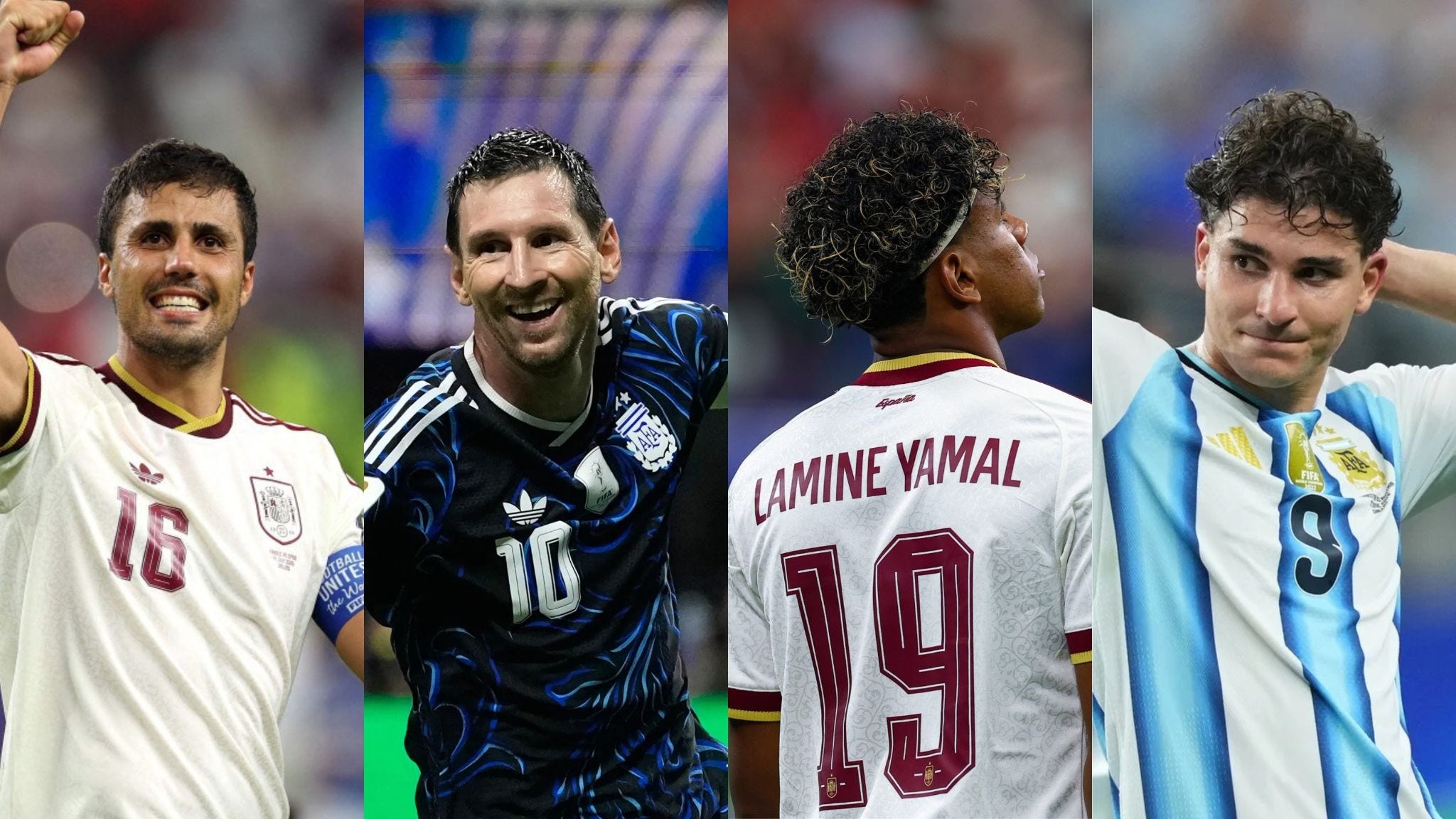
This World Cup has spent the last month pulling in two different directions.
Spain have played as though every game could be organized, controlled and slowly bent to their will. Argentina have spent the knockout rounds proving that some matches cannot be controlled at all, only survived.
That is how they arrived in the final.
Spain have conceded only one goal in seven matches. Argentina have scored a tournament-high 19, although they have also conceded seven on their way back to the stage they conquered four years ago. One has looked like the competition’s most complete team. The other has repeatedly looked vulnerable before reminding everyone why it is still the world champion.
After 103 matches, there is nobody left except each other.
Throughout the past month, I kept waiting for someone to force Spain into a different game.
Portugal defended deep enough to make the Round of 16 uncomfortable. Belgium produced periods of pressure in the quarterfinals. France arrived in the semifinal with Kylian Mbappé, Ousmane Dembélé and Michael Olise capable of turning one turnover into an opportunity within seconds.
None of them changed the kind of match Spain wanted to play. Spain kept changing them instead.
That has been the major characteristic of Luis de la Fuente’s team. Spain uses the ball to decide where the game is played, how quickly it moves and how little opponents are allowed to attack an unsettled defense.
Rodri has been at the center of it all. He has completed a World Cup-record 648 passes. His positioning stops danger before it becomes obvious enough for anyone else to notice.
Around him, everything fits. Fabián Ruiz finds pockets that defenders struggle to track. Lamine Yamal stretches back lines until openings appear between them. Spain can commit their fullbacks forward without making the entire structure feel vulnerable.
The result is a team that attacks with numbers but barely seems to be taking a risk.
Spain’s defensive record shows how difficult they have been to threaten. They have conceded only once in seven matches, and their tournament-leading 343 forced turnovers help explain why opponents haven’t been able to attack an unsettled defense. Even France’s transition-heavy attack couldn’t force the semifinal into the open, end-to-end contest it needed.
What has impressed me most is something that doesn’t appear in those numbers.
Spain never look impatient.
Knockout football has a way of convincing teams they need to force the next attack. A blocked shot becomes a rushed pass. One frustrating moment becomes five minutes of chasing a goal that isn’t there yet.
Spain avoids falling into that trap. Portugal frustrated them. Belgium made them wait. Austria stayed organized for stretches of their Round of 32 meeting. Spain never abandoned the principles that brought them there.
They trusted that the match would eventually return to the version they wanted. It almost always did.
Argentina have experienced the tournament from the opposite perspective.
Watching the defending champions has felt like watching a team repeatedly solve whatever problem appears in front of it.
Cape Verde pushed Argentina to the edge in the Round of 32. Egypt took a two-goal lead in the next round before Lionel Scaloni’s side produced one of the tournament’s best comebacks. England then led the semifinal until the 85th minute, only for Enzo Fernández to equalize before Lautaro Martínez completed the comeback in stoppage time. Lionel Messi created both goals, first finding Fernández and then delivering for Martínez’s winning header.
None of those victories looked the same. That may be exactly why Argentina are back in another World Cup final.
There is an adaptability to Scaloni’s team that numbers cannot fully explain. Some nights Messi slows the situation until he sees a pass nobody else does. Other nights Julián Álvarez makes the shot, Fernández takes control of midfield or Martínez changes the game after coming from the bench.
It has never been one tactical pattern. It has been their refusal to treat a bad moment (or even a two-goal deficit) as the final version of the match.
Argentina no longer need to dominate a match to believe they will win it. Falling behind has not broken them. Losing control has not scared them. The moments that should have created panic have instead brought out some of their best football.
That is the center of the final.
The buildup will understandably be reduced to two faces. Messi is 39 and potentially one victory away from completing the greatest final chapter international football has seen. Yamal is 19 and already playing with the confidence of someone who expects the game to change whenever the ball reaches him. One represents the era Argentina is trying to extend. The other looks like the beginning of whatever Spain will become next.
Both deserve the attention.
However, the final will not be decided by which star produces the better highlight.
Argentina must make Spain uncomfortable in midfield. Rodrigo De Paul and Enzo cannot allow Rodri to receive the ball, turn and choose the direction of the next attack without pressure.
That is difficult enough under normal circumstances. It becomes even harder against a team that has spent the tournament waiting for opponents to become impatient.
Argentina will want moments of chaos. They have the players to turn one loose ball or broken shape into a chance before Spain can recover. Messi does not need repeated opportunities. Álvarez does not need much room to run, and Martínez has shown that he can enter late and immediately make an impact.
Spain will try to prevent those moments from existing.
That is more interesting to me than possession against counterattacks or youth against experience. This is a final between one team that has spent a month reducing the number of things that can go wrong and another that has learned it can survive when almost everything does.
There’s history here too.
Argentina can become the first men’s team since Brazil in 1962 to defend their World Cup championship. It would be the country’s fourth title and would elevate Scaloni’s team from a great champion to one of the most accomplished international sides of the modern era.
Spain are seeking their second World Cup after winning in 2010. Victory would complete a European Championship/World Cup double and confirm that this generation belongs alongside the team that dominated international football from 2008 through 2012.
Neither side reached this point by accident, but they have offered completely different answers to the question every tournament asks: How do you win when one mistake could send you home?
Spain’s answer has been to limit the opportunities for that mistake to happen. Argentina has been to believe the mistake does not have to be the end.
I have thought for most of this tournament that Spain were the best team in it. Argentina has given me more reasons to question that conclusion with every comeback, but I keep returning to the same thought.
Who has actually made Spain play a different game?
Portugal came closest. Belgium had moments. France had the attacking talent to do it and never managed to create the kind of game it needed. Each opponent eventually found itself playing at Spain’s tempo, in Spain’s spaces and under Spain’s terms.
Argentina will create chances. Messi will have his say, and the defending champions have earned far too much respect for anyone to expect an easy afternoon. They have spent this tournament finding a way out every time the path appeared closed.
This time, I think they have finally reached the team that will not leave enough room for another escape.
Prediction: Spain 2–1 Argentina.
Spain have spent this World Cup taking possibilities away. Argentina survived by finding one more whenever they needed it.
I think Spain will finally leave them without one.